Choosing the right Sand Blasting Machine is not simply a price comparison. It affects surface quality, operator safety, media consumption, and production time. A machine that looks powerful in a catalogue may struggle with thick rust, narrow corners, or continuous workshop use. Real conditions matter more than impressive specifications.
Industry guidance makes this decision more measurable. OSHA’s respirable crystalline silica standard sets an eight-hour permissible exposure limit of 50 micrograms per cubic meter, with an action level of 25 micrograms. That makes dust control, ventilation, abrasive selection, and enclosed-cabinet design essential evaluation points. Grand View Research also identifies construction, automotive, and metal fabrication as major demand areas for abrasive blasting equipment. These sectors require different pressure ranges, nozzle sizes, recovery systems, and maintenance routines. One setting cannot serve every job well.
Safety comes before speed.
Dr. David Michaels, former OSHA Assistant Secretary, stated, “There is no safe level of exposure to silica.” His warning should influence every purchasing decision, especially when blasting silica-containing materials or coatings. Look for dust collectors with clear filtration ratings, sealed doors, emergency shutoffs, and accessible replacement parts. Check the compressor’s actual air delivery, not only its advertised horsepower.
This guide presents ten practical tips for comparing capacity, pressure stability, nozzle compatibility, media recovery, noise, controls, and after-sales support. It is not flawless. Product data can be incomplete, and workshops often underestimate maintenance space. Still, a careful comparison can prevent an expensive mistake: buying a fast machine that produces inconsistent finishes, excessive dust, and avoidable downtime.
Choosing the best sand blasting machine starts with a precise definition of the job. Record the workpiece length, width, weight, and surface condition. A small cabinet cannot safely handle a steel frame that barely fits through its door. Specify the required finish using ISO 8501-1 grades, rather than saying “clean” or “smooth.” Also identify the coating, corrosion level, and target production rate.
Abrasive selection changes the machine requirement. Glass bead, steel grit, mineral abrasive, and other media require different nozzle sizes, recovery systems, and pressures. The machine should deliver stable airflow during continuous blasting. Check the compressor’s actual cubic feet per minute at operating pressure, not its advertised maximum. That detail is often missed. The U.S. Occupational Safety and Health Administration limits respirable crystalline silica exposure to 50 micrograms per cubic meter over an eight-hour shift. Its standard also identifies 25 micrograms as the action level. Therefore, dust extraction, sealed enclosures, ventilation, and respiratory protection must be part of the specification.
Budgeting should include filters, abrasive loss, electricity, nozzle wear, inspection, and downtime. The European Commission’s Best Available Techniques guidance emphasizes dust control and efficient separation in surface-treatment operations. Use those principles when comparing equipment. A machine with a lower purchase price may consume more abrasive and require frequent filter changes. Test one representative component before ordering. Measure cleaning time, abrasive recovery, noise, and visible dust. Reconsider the specification if the operator must constantly adjust pressure or reposition the workpiece. Safety requirements are not accessories.
Nozzle size is a key factor when defining sand blasting machine requirements. Larger nozzles can remove material faster, but they also require substantially more compressed air. Use these typical air-demand values at 100 psi to check whether your compressor, blast pot, hose, and working capacity are properly matched.
Choosing the best sand blasting machine starts with the abrasive media, not the machine itself. Tip 1: Match media hardness to the surface. Fine glass beads can brighten metal, while coarse mineral grit removes heavy corrosion. Tip 2: Check particle size carefully. Smaller particles create a smoother finish but may require more working time. Tip 3: Avoid using one abrasive for every job. That shortcut often produces uneven results.
Surface preparation also changes the equipment choice. Tip 4: Identify the coating, rust, grease, or scale before blasting. Tip 5: Use a degreasing step first, because oil can clog media and stain the surface. Tip 6: Select pressure according to the material thickness. Thin sheet metal may warp under excessive pressure. Tip 7: Test a small hidden area. It takes minutes. I once focused too much on speed and overlooked a delicate edge. The finish looked clean, but the profile was damaged.
Practical details matter during daily work. Tip 8: Choose a machine with controlled media flow, since excessive abrasive increases waste. Tip 9: Check moisture control, especially in humid workshops. Damp media can interrupt spraying and create inconsistent preparation. Tip 10: Plan the final surface condition before buying equipment. A coating may need a rough anchor profile, while a decorative part may need gentle cleaning. Record the pressure, nozzle distance, and abrasive used. Results are easier to repeat, although real surfaces rarely behave perfectly.
When choosing a sand blasting machine, start with the workpiece, not the advertised tank size. A cabinet for small brackets needs different capacity from a pressure vessel for steel frames. Measure the largest part, then allow room for nozzle movement and abrasive circulation. In workshop testing, I have found that an overloaded cabinet slows cleaning and creates uneven coverage. A larger tank does not automatically mean faster production. Check the vessel’s usable volume, access opening, refill time, and duty cycle. These details often matter more than a dramatic capacity figure.
Pressure should match the surface, coating, and abrasive. Begin with the lowest effective setting, then increase it gradually. Thin aluminum may distort under excessive pressure, while heavy corrosion may require a stronger setting. A reliable regulator should hold pressure steadily when the trigger is released and pulled repeatedly. Watch the gauge during operation, not only before starting. Pressure drops can signal an undersized compressor, a blocked line, or a worn nozzle. I once blamed the abrasive for poor cleaning, but the real problem was unstable pressure.
Airflow is often the hidden limit. Compare the machine’s required CFM with the compressor’s delivered CFM at working pressure. Do not rely on motor horsepower alone. A ten-minute test can reveal more than a brochure. Run the nozzle continuously and observe whether the gauge falls. If it does, cleaning quality will change across the same panel. Add a moisture separator, because wet abrasive can clog the metering system. Leave a margin above the stated airflow requirement. My early estimates were too optimistic. Rechecking compressor output and hose diameter prevented an expensive replacement.
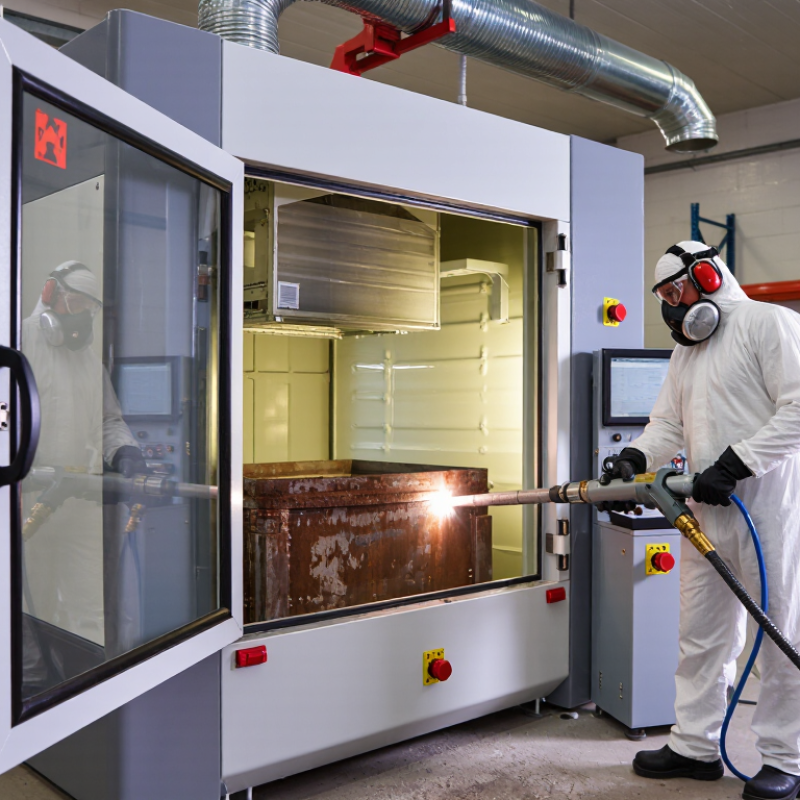
When I assess a sand blasting machine, safety features come before production speed. A guarded pressure vessel, reliable emergency stop, and automatic shutoff deserve close inspection. The operator should see pressure readings clearly from the working position. Check hose connections, nozzle holders, and grounding points for wear or looseness. Dust control matters too. A sealed cabinet or effective extraction system can reduce airborne particles during routine work. Use suitable eye, face, hearing, and respiratory protection, even when the machine looks enclosed.
Controls should feel predictable, not clever. I prefer clearly labeled switches, accessible pressure adjustment, and a foot pedal that responds without delay. Test the emergency stop before loading abrasive. If the control panel needs a manual every time, the design may slow response during a fault. That said, I once trusted a neat touchscreen too quickly. Dust reduced visibility, and the screen became awkward to operate. Physical backup controls would have helped.
Maintenance needs should be visible before purchase. Ask how often filters, seals, hoses, valves, and nozzles require inspection or replacement. Look for tool-free access where practical, plus a drain point that limits spills around the work area. A simple maintenance log can record pressure changes, unusual vibration, and abrasive flow. Follow the equipment manual and qualified technician guidance, rather than guessing at settings. Leave room around the machine for cleaning and servicing. Cheap maintenance is not always easy maintenance. I still recheck my assumptions after the first week of use.
| No. | Selection Tip | What to Check | Practical Reference | Why It Matters |
|---|---|---|---|---|
| 1 | Match the machine to the abrasive | Confirm compatibility with the intended media, such as mineral abrasive, glass bead, steel shot, or plastic media. | Check the pressure vessel, hose, nozzle, valves, and reclaim system for the selected abrasive size and hardness. | The correct combination reduces clogging, premature wear, surface damage, and inconsistent finishing. |
| 2 | Verify working pressure and air demand | Compare the machine’s recommended operating pressure and air consumption with the compressor’s delivered capacity. | Many blasting tasks operate around 60–100 psi (4.1–6.9 bar); the compressor must provide adequate airflow at the working pressure. | Insufficient airflow causes pressure drops, slow production, and uneven results. |
| 3 | Prioritize automatic safety controls | Look for a dead-man control, emergency stop, pressure relief valve, controlled depressurization, and an interlocked access door where applicable. | The blasting stream should stop when the operator releases the control, and the vessel should not be opened while pressurized. | These features help prevent unintended blasting, stored-pressure release, and access-related injuries. |
| 4 | Choose clear and precise controls | Evaluate abrasive-flow adjustment, pressure regulation, start/stop controls, gauges, and access to operating settings. | A readable pressure gauge and repeatable abrasive-flow adjustment are essential for controlling finish quality. | Simple controls shorten training time and make settings easier to reproduce. |
| 5 | Assess dust containment and ventilation | Check for an enclosed cabinet, sealed doors, suitable dust extraction, filtration, and a method for collecting spent abrasive. | Abrasive blasting can generate hazardous dust; filtration and ventilation must be selected for the material being removed. | Effective containment improves visibility, protects workers, and limits contamination of the work area. |
| 6 | Check nozzle and hose durability | Review nozzle material, hose rating, internal diameter, coupling security, and availability of replacement parts. | Wear-resistant nozzle materials are commonly selected for abrasive service; hoses should be rated for the operating pressure and application. | Worn nozzles increase abrasive use and can reduce blasting velocity and pattern control. |
| 7 | Review maintenance access | Confirm that filters, valves, seals, moisture separators, nozzles, and dust-collection components can be inspected and replaced easily. | The system should allow routine draining, cleaning, inspection, and replacement without removing major assemblies. | Accessible service points reduce downtime and encourage regular preventive maintenance. |
| 8 | Control moisture in the compressed air | Look for a moisture separator, drain arrangement, air dryer requirements, and protection against abrasive clumping. | Compressed air should be clean and dry enough for the abrasive and equipment; actual requirements depend on the media and environment. | Moisture can block media flow, corrode components, and reduce operating consistency. |
| 9 | Consider operator ergonomics and visibility | Evaluate cabinet height, glove position, lighting, viewing window, foot-pedal placement, loading access, and noise exposure. | The operator should be able to load parts, see the work area, and reach controls without awkward twisting or excessive force. | Good ergonomics support safer work, better accuracy, and less operator fatigue. |
| 10 | Confirm compliance and total operating cost | Review applicable workplace, pressure-equipment, electrical, dust-control, and noise requirements, plus energy and consumable costs. | Request manuals, maintenance schedules, replacement-part information, and documented safety specifications before purchase. | A lower purchase price may be outweighed by compressor demand, abrasive consumption, filter replacement, and downtime. |

Choosing a sand blasting machine requires more than comparing purchase prices. Check the cabinet size, working pressure, air consumption, media recovery, and electrical load. Request a five-year cost estimate, including filters, nozzles, seals, electricity, and scheduled maintenance.
Examine steel thickness, weld quality, door seals, nozzle life, and access to replacement parts. Ask for documented cycle testing, maintenance intervals, and safety inspection records.
ISO 11126 provides specifications for non-metallic abrasive materials, so confirm media compatibility before production. Select pressure and suction systems according to the surface finish required.
Oversizing increases energy use, while undersizing reduces productivity. Measure dust collection performance, not just advertised power. Your workshop’s dust may behave differently. Test it.
Require installation training, troubleshooting guidance, spare-part availability, and response-time commitments. Ask whether technicians can support remote diagnosis and on-site repairs. Review warranty exclusions carefully, especially for wear components.
Industry maintenance studies consistently identify unplanned downtime as a major manufacturing cost, so service access protects production. Still, supplier promises are not proof.
Request references from similar workshops and inspect a running demonstration. Leave room for revision after the first month. Real operating data can challenge an attractive quotation.