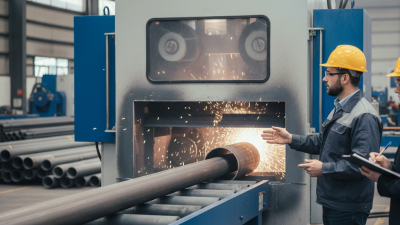
Belt Shot Blasting Machine manufacturers are gaining attention as foundries, steel processors, and automotive suppliers demand faster, cleaner surface preparation. The World Steel Association reported approximately 1.89 billion tonnes of crude steel production in 2023. That volume creates a large market for reliable descaling and finishing equipment. However, steel output alone does not prove machine quality.
MarketsandMarkets identifies automation, energy efficiency, and process consistency as major trends in the global shot blasting machine market. These trends explain why buyers compare turbine design, belt materials, loading capacity, dust collection, and abrasive recovery. A machine may look impressive in a showroom. Its real test appears beside a hot, uneven casting line.
Dr. John D. Keane, a surface-treatment engineering consultant, explains, “A clean part is not necessarily a prepared part; repeatability makes the difference.” This practical view should guide any worldwide manufacturer comparison. Suppliers must show measured cycle times, media consumption, maintenance intervals, and achievable surface results. Photos are useful. Test data is stronger.
The best manufacturers usually provide application trials, documented quality systems, and regional technical support. ISO 9001 certification can indicate controlled processes, but it cannot guarantee excellent blasting performance. Buyers should inspect spare-part availability and service response, too. Small details become expensive during downtime.
This ranking will compare leading Belt Shot Blasting Machine manufacturers through engineering capability, customization, operating reliability, and customer evidence. The comparison is not perfect. Public data varies between suppliers, and some claims remain difficult to verify. That uncertainty deserves attention, not optimistic assumptions.
Belt shot blasting machines are commonly selected for castings, forgings, and heat-treated parts weighing 15 to 250 kilograms. Their rotating rubber belt lifts and tumbles components through a controlled stream of abrasive media. This movement exposes multiple surfaces without manual repositioning. The result depends heavily on part shape, loading pattern, and cycle time.
Most production systems use two to four turbines. Turbine quantity affects coverage, throughput, and power demand. Abrasive speed typically ranges from 60 to 90 meters per second. Higher speed is not automatically better. Excessive impact can damage thin edges, deform small features, or accelerate belt wear. A practical setup balances turbine speed, shot size, and exposure time. Operators should check surface cleanliness with consistent lighting and documented samples.
Load testing reveals the real performance. A 15-kilogram batch may tumble freely, while a 250-kilogram load can hide contact areas. Overloading reduces cleaning uniformity. It may also increase vibration and motor stress. Inspectors should examine belt ribs, turbine blades, liners, seals, and dust filters during routine checks. Small cracks matter. Energy use deserves attention too, because four turbines may improve coverage but raise operating costs. Actual results can vary more than catalog figures suggest, especially with mixed part sizes. That uncertainty should be measured, not ignored.
Choosing top belt shot blasting machine manufacturers worldwide requires more than comparing catalogue prices. Throughput is a practical starting point. Machines rated from 200 to 1,500 kg/h suit different production scales, but stated capacity can vary with part shape, loading density, and surface condition. A small casting may tumble efficiently. Long or fragile parts may reduce the real output.
A serious supplier should document test conditions, belt material, turbine power, and dust-control performance. Ask for production trials using representative parts. Measure cleaning time, abrasive consumption, surface coverage, and operator access. Abrasive size also matters. The 0.2–0.4 mm range can support finer cleaning, while 0.6–1.0 mm abrasive may remove heavier scale faster. The wrong size can leave shadows or create unnecessary surface impact.
Look for manufacturers that provide measurable acceptance criteria, spare-parts planning, and accessible maintenance points. Inspect the belt design closely. Its openings, flexibility, and load rating affect both throughput and part protection. A machine reaching 1,500 kg/h on paper may deliver less in a crowded workshop. That is the uncomfortable detail. Energy use, recovery efficiency, and downtime should be included in the comparison. No single specification proves quality. Independent trials remain valuable. Ask difficult questions. Expect precise answers.
Top Belt Shot Blasting Machine Manufacturers Worldwide?
Europe remains strong in precision engineering and customized belt shot blasting systems. Manufacturers often emphasize heavy welded frames, stable turbine performance, and dust-control integration. Their machines suit foundries, heat-treatment plants, and steel component lines. Buyers should inspect abrasive circulation during a live production test. A polished brochure cannot show maintenance difficulty.
China offers broad production capacity and competitive equipment pricing. Many suppliers provide standard machines quickly, while experienced factories also develop customized belt widths and loading systems. Quality can vary between workshops. Check weld consistency, gearbox access, spare-part documentation, and controller reliability. A factory video is useful, but an independent inspection is better.
Japan is associated with careful automation, compact layouts, and consistent process control. These systems can perform well where floor space is limited and surface quality must remain stable. North American manufacturers commonly focus on rugged construction, service access, and integration with existing production cells. Local support may reduce downtime, especially for large machines. Still, regional assumptions can mislead. European equipment is not always easier to maintain, and lower-cost Chinese equipment is not automatically inferior. Technical drawings, test samples, energy data, and references from similar applications deserve more attention than country labels. Manufacturers should explain belt loading, media recovery, noise levels, and realistic cleaning capacity in measurable terms. Some published capacities seem optimistic. That deserves questioning.
Top Belt Shot Blasting Machine Manufacturers Worldwide?
Comparing belt shot blasting machine suppliers requires more than checking turbine motor power. A larger motor may increase output, but wheel efficiency, abrasive flow, and throwing pattern matter just as much. Ask for measured cleaning rates using your actual castings and shot size. Small differences become expensive during continuous production.
Belt life depends on more than rubber thickness. Inspect the compound, belt seam, support rollers, and maximum part weight. Sharp edges can cut a belt quickly. Operators should also check belt tracking after loading uneven parts. A supplier offering replacement data and maintenance intervals appears more reliable than one promising “long life” without test records.
Dust control deserves close attention. Look for balanced airflow, filter pressure monitoring, sealed transfer points, and easy-access inspection doors. ATEX safety requires careful review, not a decorative certificate. Confirm dust classification, grounding, spark control, explosion venting, and documented protective measures for the intended installation. Requirements may differ by market and dust type. Ask for technical files and conformity evidence. Site training matters too. In practice, even a well-designed machine can underperform when filters clog or operators bypass alarms. That uncomfortable detail should be part of every supplier comparison.
| Anonymous Supplier Profile | Typical Machine Configuration | Turbine Power Range | Approx. Shot-Blasting Capacity | Belt Material and Expected Service Life | Dust-Control Arrangement | ATEX Safety Readiness | Best-Fit Applications |
|---|---|---|---|---|---|---|---|
| Supplier Profile A | Continuous rubber-belt machine with a single high-efficiency wheel | 7.5–15 kW per turbine | Approximately 1.5–4.0 tonnes/hour, depending on part geometry and abrasive dose | Oil-resistant rubber belt with replaceable links; commonly 2,000–5,000 operating hours under balanced loading | Cartridge filter, automatic pulse cleaning, abrasive pre-separator, and differential-pressure monitoring | High ATEX-oriented dust extraction options available; final compliance depends on dust classification and installation |
Automotive castings, forgings, and medium-size batch production |
| Supplier Profile B | Heavy-duty continuous belt system with two turbines | 11–22 kW per turbine | Approximately 3.0–8.0 tonnes/hour for bulk metallic parts | Manganese-steel or reinforced rubber belt; commonly 3,000–7,000 operating hours, subject to impact and part weight | Two-stage cartridge filtration, spark-resistant ducting options, and continuous dust-level indication | High Suitable for projects requiring documented zoning, grounding, isolation, and explosion-relief review |
Foundry shakeout lines, structural components, and high-volume forgings |
| Supplier Profile C | Compact tumble-belt machine with adjustable blast cycle | 5.5–11 kW per turbine | Approximately 0.8–2.5 tonnes/hour | Replaceable rubber belt and wear-resistant flights; commonly 1,500–4,000 operating hours | Single cartridge filter with pulse cleaning and manual or automatic air-volume adjustment | Medium ATEX-compatible components may be specified, but the extraction system must be engineered for the actual dust hazard |
Job shops, maintenance departments, small castings, and mixed-batch production |
| Supplier Profile D | Continuous belt machine with variable-speed turbine and automatic abrasive recycling | 9–18.5 kW per turbine | Approximately 2.0–5.5 tonnes/hour | Rubber belt with modular wear sections; commonly 2,500–6,000 operating hours when part loading is controlled | High-efficiency cartridge collector, automatic pulse cleaning, cyclone pre-cleaner, and sealed transfer points | High Strong option where dust monitoring, grounding, and documented maintenance procedures are required |
Heat-treated components, aluminum castings, and export-oriented production plants |
| Supplier Profile E | Heavy-load tumble belt with abrasion-resistant internal lining | 15–30 kW per turbine | Approximately 4.0–10.0 tonnes/hour | Heavy-duty rubber or steel-linked belt; commonly 3,000–8,000 operating hours, depending on part mass and sharp edges | Large-capacity cartridge or bag filter, automatic cleaning, abrasive separator, and optional airflow control | Medium to High ATEX design review should cover filter placement, explosion venting, isolation, and combustible-metal dust risks |
Large steel parts, heavy forgings, agricultural components, and continuous industrial lines |
| Supplier Profile F | Flexible batch belt machine with recipe-based controls | 7.5–18.5 kW per turbine | Approximately 1.0–3.5 tonnes/hour | Interchangeable rubber belt sections; commonly 2,000–5,000 operating hours with correct loading and abrasive grading | Compact cartridge collector, automatic pulse cleaning, sealed loading door, and optional HEPA polishing filter | Medium Can be configured for hazardous dust environments after site-specific risk assessment and certification review |
Contract finishing, general engineering, and variable product mixes |

Choosing among top belt shot blasting machine manufacturers worldwide requires more than comparing purchase prices. Energy use deserves measured attention. The U.S. Department of Energy reports that compressed air can consume 10–30% of industrial electricity. Its guidance also notes that leaks may waste 20–30% of compressed air. A machine with efficient turbines, sealed cabinets, and a properly sized dust collector can reduce operating costs. Ask suppliers for kWh per batch, abrasive consumption, and dust-collector load under real production conditions. Brochure figures can mislead.
Service coverage is equally practical. Check local technician availability, spare-parts stock, remote diagnostics, and guaranteed response times. A delayed bearing or belt can stop an entire production line. Warranty terms need careful reading. Some warranties cover the main frame but exclude wear plates, seals, belts, and turbine blades. The European Commission’s surface-treatment guidance emphasizes maintenance, filtration, and process control as important environmental and operating factors. Those details directly affect total cost of ownership.
Tips: Request a five-year cost model. Include electricity, abrasive replacement, filters, labor, downtime, inspections, and disposal. Compare identical workloads, not empty-machine tests. Ask for references from facilities with similar steel thickness and throughput. I would not trust one factory visit alone. Hidden maintenance costs often appear after installation, and even a strong specification can fail without trained operators. A small energy saving may become significant when the machine runs two shifts daily.