Leave Your Message

Top Shot Blasting Equipment Manufacturers Worldwide

Choosing among the top Shot Blasting Equipment manufacturers worldwide requires more than comparing machine prices. Surface preparation affects coating adhesion, fatigue resistance, production speed, and workplace cleanliness. A reliable manufacturer should understand these connections.

W. Edwards Deming, a leading authority on industrial quality, said, “Quality comes not from inspection, but from the improvement of the production process.” This principle applies strongly to shot blasting. Consistent wheel speed, controlled abrasive flow, stable blast coverage, and effective dust collection shape the final result. Small variations can leave shadows inside a steel beam or uneven profiles on cast components.

This guide examines global manufacturers through practical and technical criteria. It considers equipment design, automation, blast turbines, chamber durability, spare-parts access, operator safety, energy use, and after-sales support. Factory experience matters too. A supplier that has installed machines in foundries, shipyards, and structural-steel plants usually understands difficult production conditions.

The comparison is not flawless. Regional data can be incomplete, and published performance figures may reflect ideal testing. Buyers should verify claims through site visits, sample trials, maintenance records, and customer references. Not every advanced system suits every workshop.

The best choice depends on the workpiece, abrasive type, throughput, surface standard, and available floor space. A compact air-blast cabinet may suit a repair shop. A continuous wheel-blast line may serve a high-volume steel plant.

Look beyond the brochure. Inspect the details. That is where reliability appears.

Top Shot Blasting Equipment Manufacturers Worldwide

Definition and Role of Shot Blasting Equipment Manufacturers

Shot blasting equipment manufacturers design machines that propel steel, mineral, or synthetic abrasives against a surface. Their role extends beyond machine fabrication. They specify wheel speed, abrasive flow, chamber geometry, dust control, and recovery systems for each application. A manufacturer also helps determine whether a foundry needs a tumble blast machine or a continuous conveyor system. That decision affects surface profile, cycle time, energy use, and worker exposure.

Market research shows why this role matters. Grand View Research estimates the global abrasive blasting equipment market will expand steadily through 2030, with automation and infrastructure renewal supporting demand. MarketsandMarkets also identifies automated surface-treatment systems as a major growth area, especially in automotive, aerospace, and metal fabrication. These reports use different market definitions, so their figures should not be compared mechanically. The gap is easy to miss.

A reliable manufacturer validates performance on the customer’s actual parts. Technicians may inspect a cast housing, measure its roughness, and record abrasive consumption during trials. They should provide test results, maintenance intervals, filtration data, and documented safety controls. Practical experience matters here. A machine can achieve a bright finish yet produce excessive dust or uneven coverage. That is not success. Manufacturers also support operator training, spare-parts planning, and process audits after installation. Some recommendations remain imperfect because production materials change, and laboratory settings rarely match a busy factory floor.

Top Shot Blasting Equipment Manufacturers Worldwide - Definition and Role of Shot Blasting Equipment Manufacturers

Equipment Category Operating Principle Typical Workpieces Common Abrasive Media Primary Manufacturer Role Key Selection Factors
Tumble Belt Shot Blasting Machine Parts tumble on a rubber or manganese-steel belt while rotating blast wheels propel metallic abrasive. Small and medium castings, forgings, fasteners and heat-treated components. Cast steel shot, steel grit and conditioned metallic mixtures. Provide a robust system for batch cleaning, descaling and deburring of bulk-loaded parts. Part geometry, allowable impact, batch size, belt durability and unloading method.
Spinner Hanger Machine Components are suspended from hooks and rotated through one or more blast zones. Large castings, fabricated parts, structural components and irregular workpieces. Steel shot, steel grit and, where specified, nonmetallic abrasive. Deliver controlled coverage for complex surfaces while reducing part-to-part contact. Maximum load, hook layout, rotation speed, blast pattern and access to recessed areas.
Rotary Table Machine Parts are placed on a rotating table and exposed to directional wheel-blast streams. Medium and large castings, gears, valves, housings and welded fabrications. Steel shot or steel grit selected according to surface profile and cleaning intensity. Offer flexible batch processing with repeatable exposure and practical operator access. Table diameter, part weight, fixture requirements, wheel arrangement and cycle time.
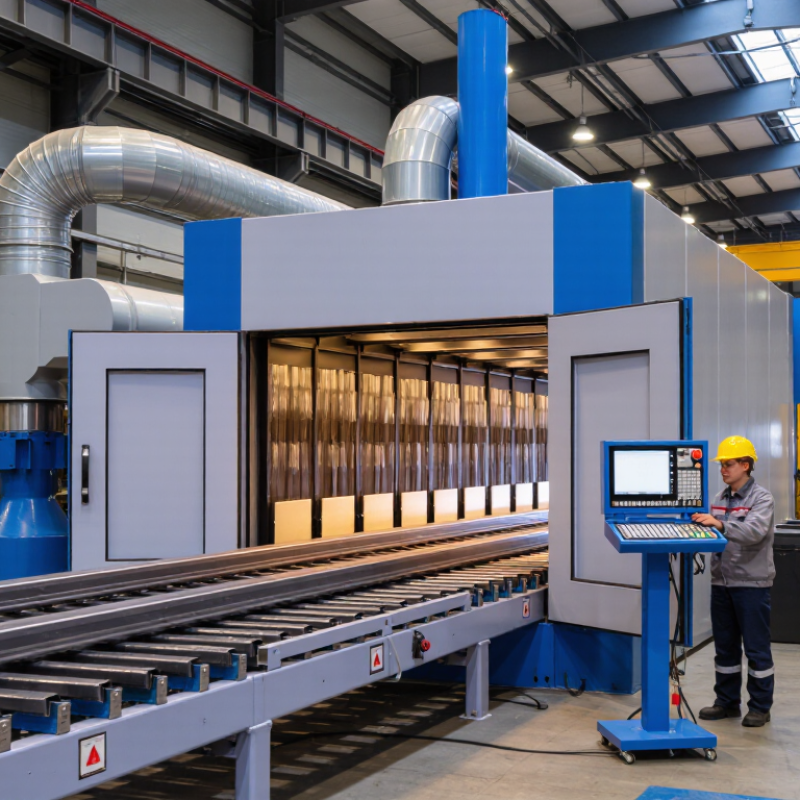
Continuous Conveyor System Parts move continuously through blast chambers on a roller, mesh or specialized conveyor. Steel plate, profiles, pipes, beams, fabricated assemblies and high-volume production parts. Steel shot, steel grit or mixed metallic abrasive systems. Integrate cleaning into automated production lines and maintain consistent throughput. Line speed, part dimensions, conveyor load, blast coverage and plant layout.
Air-Blast Cabinet Compressed air accelerates abrasive through a nozzle toward manually positioned components. Precision parts, prototypes, maintenance items, tooling and small production batches. Steel grit, glass bead, aluminum oxide, ceramic bead or other specified media. Supply versatile equipment for localized cleaning, finishing and surface preparation. Nozzle size, air pressure, cabinet dimensions, media recovery and operator ergonomics.
Blast Room Operators clean large components inside an enclosed room using portable pressure or suction blast equipment. Heavy machinery, storage tanks, ship sections, bridges and oversized fabricated structures. Steel grit, mineral abrasive or other media permitted by the process and regulations. Engineer containment, ventilation, abrasive recovery, lighting and worker protection. Room volume, dust-control capacity, floor recovery design, access doors and safety systems.
Roller Conveyor Plate Blaster Flat or formed steel travels on powered rollers through multiple overhead and side blast wheels. Steel plates, beams, channels, angles and fabricated structural sections. Steel shot and steel grit, commonly combined with downstream brushing or air cleaning. Provide uniform mill-scale removal and surface preparation before coating or fabrication. Material width, thickness, line speed, surface standard and integration with painting lines.
Wire Mesh Belt Machine Parts pass through a blast chamber on a mesh belt that allows access to multiple surfaces. Castings, aluminum components, sheet-metal parts and delicate components requiring controlled handling. Fine or medium steel shot, steel grit and selected nonmetallic media. Balance comprehensive coverage with reduced impact and continuous material flow. Belt opening, part size, loading pattern, blast intensity and risk of part entanglement.
Abrasive Recovery and Dust-Collection Module Separators reclaim reusable abrasive while cartridge or bag filters remove airborne dust from exhaust air. Used with cabinets, blast rooms and automated wheel-blast machines. Reusable metallic abrasive separated from fines, broken particles and process dust. Improve media efficiency, visibility, housekeeping and compliance with workplace exposure controls. Airflow, filter area, dust loading, separator efficiency, noise and maintenance access.
Control and Automation Package Sensors, programmable controls, variable-speed drives and interlocks regulate the blasting process. Batch and continuous production lines requiring repeatable treatment records. Media selected for the machine process, component material and required finish. Standardize cycle parameters, monitor equipment condition and connect blasting with upstream and downstream operations. PLC compatibility, recipe management, data logging, safety interlocks and remote diagnostics.
Industry Reference: Surface preparation results are commonly specified using visual cleanliness grades such as Sa 2, Sa 2½ and Sa 3 under ISO 8501-1. Final equipment selection should also consider abrasive type, dust-control requirements, production volume, component geometry and applicable occupational-safety regulations.

Key Technologies Used in Modern Shot Blasting Systems

Top Shot Blasting Equipment Manufacturers Worldwide

Modern shot blasting systems rely on controlled impact, not simply stronger airflow. Wheelblast turbines accelerate steel abrasive through rotating blades. Compressed-air nozzles suit narrow cavities and irregular parts. Experienced operators select media size, hardness, and flow rate together. A small change can alter the anchor profile.

Sensors measure turbine speed, cabinet pressure, abrasive level, and dust loading. PLC controls adjust feed rates and trigger alarms before surface quality declines. Variable-frequency drives reduce energy waste during partial loads. Robotic nozzle paths improve coverage on complex castings. Still, programming is not magic. A poorly chosen angle leaves shadowed areas.

Modern separators remove fines and broken particles from reusable media. Magnetic separation handles ferrous debris, while air classification controls particle distribution. Cartridge collectors capture airborne dust and monitor pressure drop. In a well-maintained cabinet, visibility remains clear near the work zone. That detail matters during inspection. I have seen quality drift when operators ignored worn liners or delayed abrasive replacement. Digital records help trace batch settings, but manual checks remain necessary. Sensors can fail. Calibration needs evidence, not assumptions. Good equipment design combines durable chambers, accessible maintenance points, guarded moving parts, and documented test procedures.

Major Shot Blasting Equipment Manufacturers by Global Region

Shot blasting equipment manufacturers vary widely by region, reflecting local industries, energy costs, and maintenance practices. Europe is known for engineered wheel-blast systems, controlled abrasive flow, and detailed safety documentation. German-speaking markets often prioritize automation and repeatable surface profiles. Italy and Spain serve foundries, fabricators, and structural steel processors with flexible machine layouts. Factory experience shows that accessibility can matter more than impressive output ratings.

North American manufacturers commonly build robust equipment for heavy fabrication, rail components, and energy-related infrastructure. Their designs often emphasize large work envelopes, simple controls, and replaceable wear liners. East Asia supplies a broad range, from compact cabinet machines to automated production cells. Japan and South Korea tend to focus on precision, monitoring, and stable cycle times. China has substantial manufacturing capacity, especially for standard machines and export-oriented systems, but supplier verification remains essential. South Asia and Southeast Asia are expanding with cost-conscious equipment for castings, ship components, and general metal preparation. Local service quality can vary sharply.

Tips: Compare turbine efficiency, chamber dimensions, dust collection, abrasive recovery, and spare-part availability. Ask for test results using your actual workpieces. Inspect welds, liner thickness, access doors, and control-panel documentation. A low purchase price may hide frequent shutdowns. I would also request references from similar plants, not just glossy brochures. Specifications alone can mislead.

Regional steel production is used as a neutral demand indicator for shot blasting equipment, since surface preparation and finishing systems are widely applied in steel fabrication, automotive manufacturing, foundries, and infrastructure projects. The figures represent 2023 crude steel production by global region and do not include company or brand-level data.

How to Compare Manufacturers, Products, and Industry Applications

Comparing shot blasting equipment manufacturers requires more than checking catalog capacity. In plant evaluations, I examine how clearly each supplier defines throughput, abrasive flow, component size, and surface profile. A credible manufacturer provides test data, machine drawings, maintenance intervals, and documented safety controls. Ask for a sample trial using your actual parts. Small differences become obvious. The cabinet may look similar, but recovery efficiency and dust capture can change operating costs significantly. This is where comparisons often become uncomfortable.

Product selection should follow the application, not a preferred machine type. Tumbling systems suit durable small components, while hanger or continuous systems handle larger or higher-volume parts. Wheel speed, blast pattern, liner material, and automation affect finish consistency. Check whether controls record cycle data and detect abnormal vibration. A strong technical team explains limitations without promising perfect results. That matters. Request references from facilities with comparable alloys, geometry, and production targets. A polished demonstration may not represent your daily workload.

Compare the full ownership picture. Review abrasive consumption, filter replacement, spare-part availability, training, installation support, and response times. Ask how performance is verified after commissioning. Independent inspection and written acceptance criteria reduce disputes. Energy data should be measured under realistic loading, not empty-machine conditions. I would also question unusually low prices. They may reflect leaner service, thinner wear parts, or missing controls. Still, expensive equipment is not automatically better. My own comparison sheets sometimes overvalue specifications and undervalue operator feedback. A short shift with real workers can reveal access problems, awkward loading, or noise that a brochure misses.

Safety, Sustainability, and Future Trends in Shot Blasting Equipment

Shot blasting equipment manufacturers worldwide are redesigning machines around worker safety, lower emissions, and measurable resource use. In practice, enclosed cabinets, interlocked doors, emergency stops, and automatic media recovery reduce exposure to abrasive dust. Local exhaust ventilation remains essential, even when a collector is installed. Operators should check airflow, filter pressure, guarding, and noise levels during every shift. Small details matter. A loose seal can turn a clean workshop into a dusty one. Training also needs updating when controls or abrasive materials change.

Sustainability is not only about electricity consumption. Durable blast wheels, recyclable steel shot, and correctly sized motors can reduce waste and maintenance. Closed-loop media systems help, but they do not eliminate contamination. Spent abrasive still requires controlled handling and documented disposal. Modern equipment increasingly uses variable-frequency drives, sensor-based media flow, and remote condition monitoring. These features can prevent overblasting and unnecessary downtime. Yet data alone cannot fix poor settings. An experienced technician must interpret vibration, surface profile, and media breakdown.

Future systems may combine machine vision, predictive maintenance, and adaptive blasting recipes. Such tools could improve consistency across large production lines. They may also create new risks, including overconfidence in automated decisions. Human review should remain part of quality control. Manufacturers with transparent test methods, clear manuals, and accessible service support deserve closer attention. In many workshops, efficiency targets overshadow operator comfort. That is a mistake worth revisiting. The safest design is one workers can understand, inspect, and challenge.